
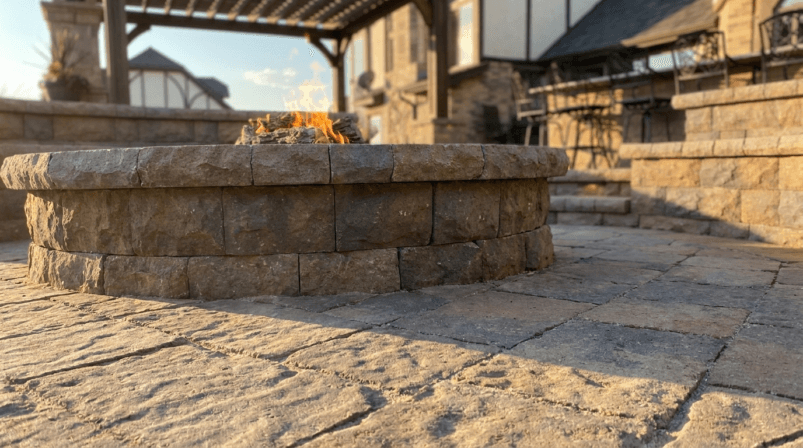
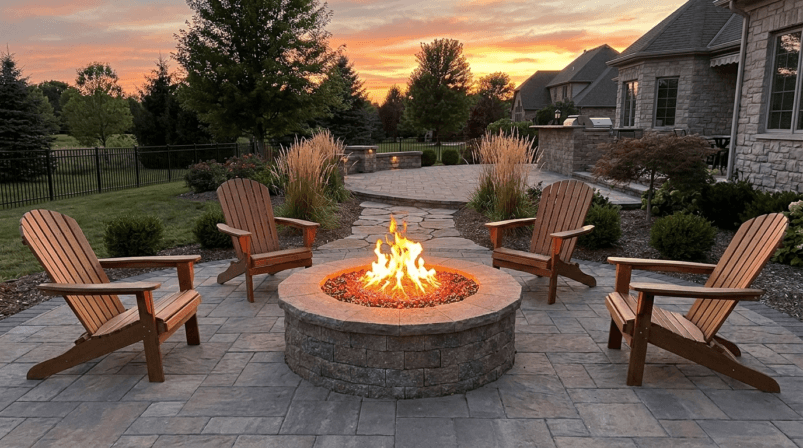
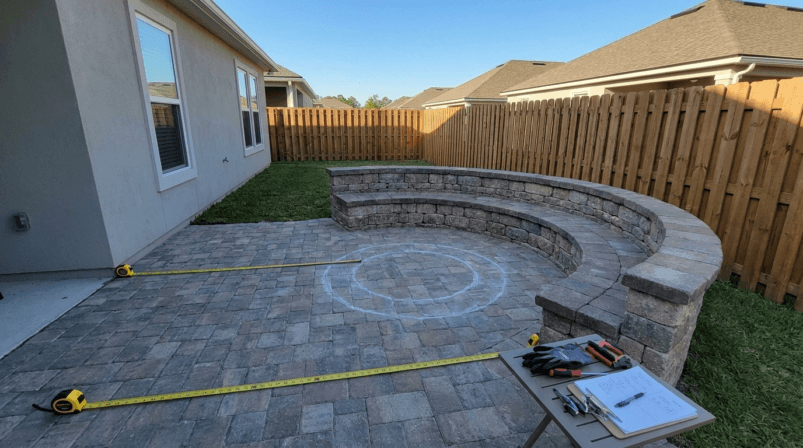
A backyard fire pit should go where safety clearances, wind direction, seating comfort, surface stability, and everyday use all work together. The right location is not always the center of the yard or the closest spot to the patio. It is the spot that gives the fire room to breathe, keeps smoke manageable, supports the right base material, and fits naturally into how people move through the backyard.
Before choosing a fire pit kit, gas unit, paver layout, or built-in seating wall, mark the location first. A good fire pit area starts with placement. Then the material, fuel type, and fire feature should be chosen around that plan.
How to Choose the Right Backyard Fire Pit Location
The best fire pit location is a level, open area with a non-combustible base, safe clearance from structures and overhead hazards, predictable airflow, and enough room for seating and movement. If a location looks good but creates smoke problems, crowding, or clearance concerns, it is not the right spot.
Use this placement check before committing to the layout:
- Clearance from structures: Keep the fire pit away from the house, garage, shed, fence, deck railing, and anything that can burn.
- Overhead space: Avoid low branches, roof overhangs, awnings, and enclosed areas unless the specific fire feature is approved for that setup.
- Fire-safe base: Use a stable, level, non-combustible surface such as pavers, brick, concrete, natural stone, or properly prepared gravel.
- Wind direction: Watch where smoke would travel during the time of day you expect to use the fire pit.
- Seating space: Leave enough room for chairs, side tables, and walking space behind the seating area.
- Traffic flow: Keep the fire pit out of main paths between the house, patio, pool, garage, gate, or play areas.
- Fuel type: A wood-burning fire pit, gas fire pit, portable unit, and built-in kit each have different placement needs.
- Local rules: Check local fire rules, HOA requirements, and manufacturer instructions before finalizing the location.
If you are still comparing fire features, Miller Brick can help you look at fire pit kits and outdoor fire options in the context of your patio layout, fuel preference, and material plan.
Why Fire Pit Placement Matters Before You Choose the Fire Pit
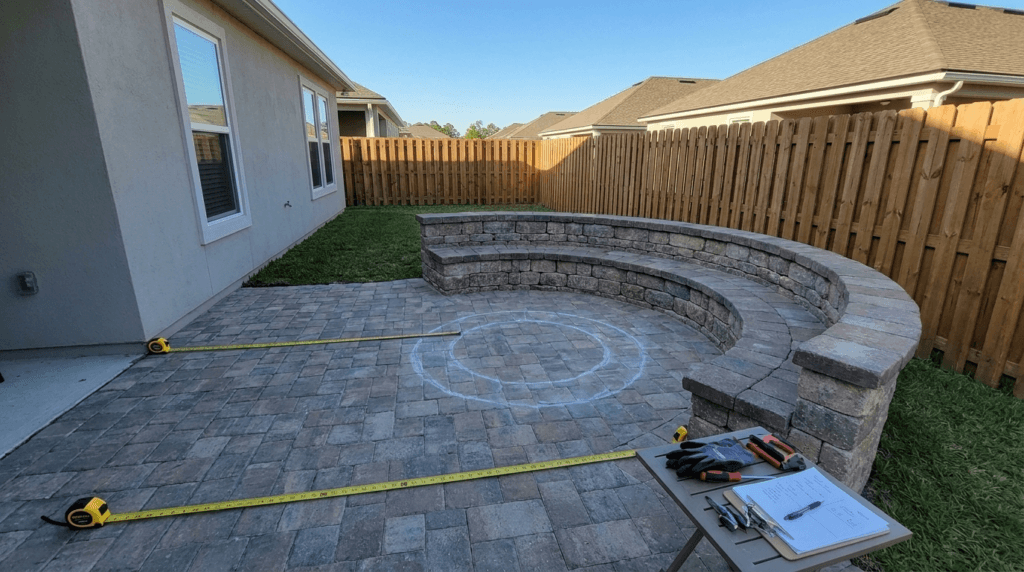
A fire pit is hard to enjoy when the location works against it. A spot that is too close to the house may create clearance concerns. A spot that catches the evening breeze the wrong way may push smoke into the seating area. A spot that sits too far from the patio may look good in a plan but feel disconnected when people actually use the backyard.
Placement also affects the type of fire pit that makes sense. A permanent fire pit kit may require a prepared base and a layout that works with pavers, stone, or a surrounding seating area. A gas fire pit may involve fuel-line planning or propane storage. A wood-burning fire pit needs more attention to smoke, sparks, ash cleanup, and wood storage.
For homeowners planning a larger patio or outdoor living area, the fire pit should be treated as part of the hardscape layout, not as a loose accessory. Miller Brick’s brand voice is built around practical local guidance, showroom support, and helping Rochester homeowners compare real material choices before committing to a project.
Start With Safety: Distance From the House, Fences, Trees, and Other Combustibles
Fire pit clearance depends on the fire pit type, manufacturer instructions, site conditions, and local rules. As a planning baseline, NFPA guidance says fire pits should be used outdoors and at least 10 feet from anything that can burn. NFPA also recommends placing fire pits on even ground or a level surface that will not catch fire, such as patio blocks, bricks, or concrete.
| Clearance Area | What to Check | Why It Matters |
|---|---|---|
| House, garage, or shed | Confirm required distance with local rules and product instructions | Reduces heat, spark, and ember risk near structures |
| Fence or deck railing | Be especially cautious with wood, vinyl, and composite materials | Heat and sparks can damage or ignite nearby materials |
| Overhanging branches | Avoid placing the fire pit beneath low limbs or dense canopy | Heat and embers rise, especially from wood fires |
| Patio furniture and cushions | Keep soft goods outside the heat zone | Fabric, outdoor pillows, and rugs can shift or catch sparks |
| Walking paths | Leave room to move around the seating area | Reduces crowding and trips near flame |
| Property line | Check municipal, HOA, or neighborhood requirements | Rules can vary by town, city, county, or association |
Do not only measure from the house. Look for mulch beds, dry leaves, stacked firewood, outdoor curtains, umbrellas, shrubs, play equipment, and stored patio items. These are easy to overlook during layout planning but matter once the fire pit is in regular use.
For wood-burning fire pits, spark control deserves extra attention. The U.S. Fire Administration recommends using a metal screen over wood-burning fires, watching children closely, and putting out the fire before leaving the backyard.
Think About Wind Direction Before You Build the Fire Pit Area
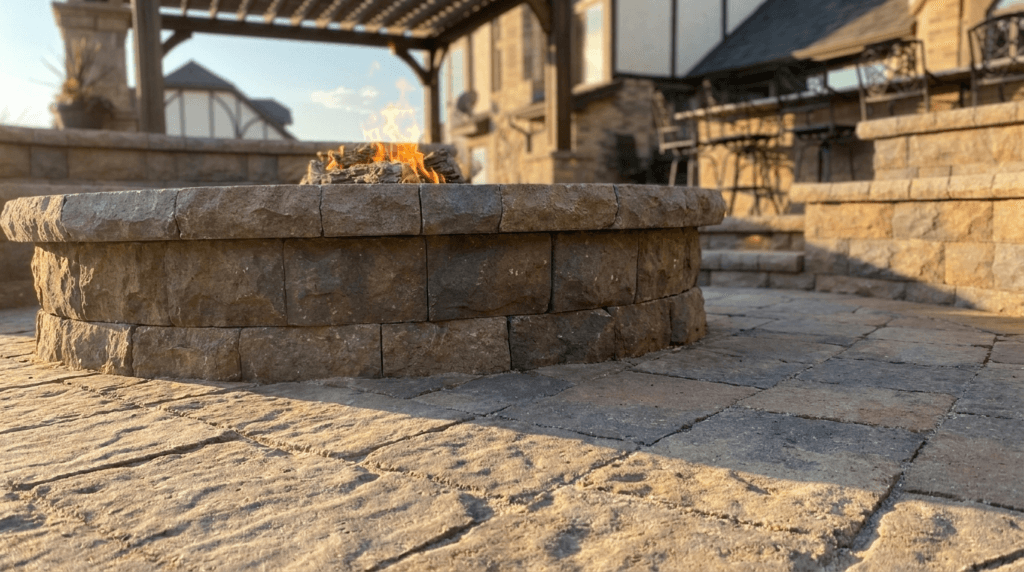
Wind is one of the biggest reasons a fire pit location fails after installation. A location can have good clearance and still be uncomfortable if smoke moves toward the seating area, patio doors, windows, or a neighbor’s yard.
This matters most with wood-burning fire pits, but gas fire pits are not completely unaffected. Wind can still influence flame behavior, heat direction, and comfort around the seating area. New York State DEC also advises checking conditions and avoiding fire use when wind or dry weather increases fire risk.
Before installing a permanent fire pit, test the location:
- Mark the proposed fire pit spot. Use flags, chalk, a hose, or temporary stones.
- Check the breeze at the right time. Test the area during the evening or weekend hours when the fire pit will actually be used.
- Watch where smoke would travel. Look at seating, windows, doors, porch screens, vents, and neighboring properties.
- Adjust before building. Moving a temporary layout is simple. Moving a built-in fire pit, gas line, or finished paver area is not.
For many backyards, the best fire pit spot is not the most visually obvious one. It is the one where smoke, heat, and seating comfort line up.
Plan the Seating Area Around the Fire Pit, Not After It
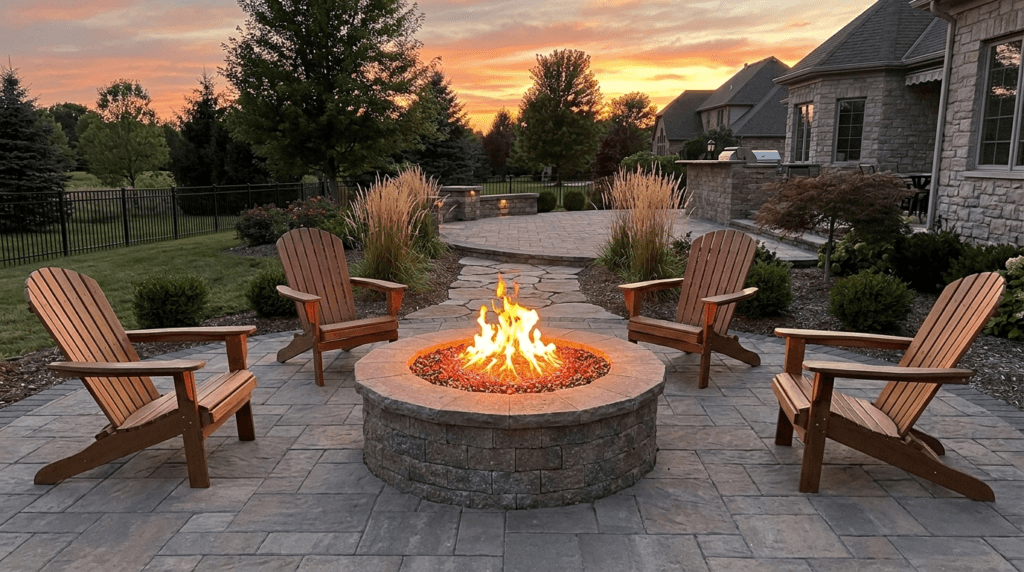
A fire pit should be placed with the seating layout already in mind. The common mistake is choosing the fire pit location first, then trying to squeeze chairs around it. That often leads to tight circulation, uneven spacing, or seats that are either too close to the heat or too far to feel connected.
Set out temporary chairs before finalizing the fire pit location. A two-chair setup for quiet evenings needs a different layout than a larger gathering area with Adirondack chairs, side tables, and a seat wall.
Good fire pit seating should account for:
- Walking room behind chairs: People should be able to move around without stepping near the flame.
- Heat comfort: Chairs should be close enough to feel warmth without forcing people into the smoke or heat zone.
- Access from the patio or house: The path to the fire pit should feel natural, especially after dark.
- View orientation: Seating should face the yard, garden, pool, or open space when possible.
- Movable or built-in seating: Movable chairs give flexibility; seat walls create a more finished hardscape design.
If the fire pit will be part of a patio, retaining wall, or outdoor living area, plan the pavers, seat wall, and walking paths together. Miller Brick’s copy guidelines emphasize concrete project language, practical guidance, and helping readers compare material choices clearly.
Choose a Surface That Can Handle Heat, Weight, and Weather
The fire pit base should be stable, level, and non-combustible. From there, think about heat exposure, weight, drainage, furniture placement, and how the material will handle Rochester’s freeze-thaw cycles.
A fire pit area that sits in a low spot can collect water. A loose or uneven base can shift under chairs. A poor surface choice can scorch, crack, stain, or become a tripping hazard. The right base depends on the fire pit type and how the space will be used.
| Surface | Placement Fit | Planning Note |
|---|---|---|
| Concrete pavers | Strong option for many fire pit areas | Use the correct base and follow fire pit manufacturer guidance |
| Natural stone | Strong visual and durable option | Confirm heat suitability, stability, and surface finish |
| Gravel | Useful for drainage and informal layouts | Must be level, contained, and compacted |
| Concrete slab | Often suitable if in good condition | Check slope, cracking, drainage, and clearance |
| Grass | Poor long-term choice | Can scorch, shift, and create unstable seating |
| Wood deck | High caution | Only use approved products and required protection |
| Composite deck | High caution | Heat can damage materials; follow product instructions closely |
Wood-Burning vs. Gas Fire Pit Placement: What Changes?
Wood-burning and gas fire pits should not be planned the same way. Both need safe clearance and a stable base, but smoke, fuel access, sparks, maintenance, and installation details change the layout.
| Factor | Wood-Burning Fire Pit | Gas Fire Pit |
|---|---|---|
| Smoke | More smoke; wind direction matters more | Less smoke, but wind can still affect flame comfort |
| Sparks and embers | Needs more spark control and open clearance | No wood embers, but still an open flame |
| Fuel planning | Requires dry wood storage and ash cleanup | Requires propane or natural gas planning |
| Installation | Portable units and kits may be simpler | May need a gas line, burner setup, or approved connection |
| Patio integration | Works best with more open-air layouts | Often easier to integrate into finished patio designs |
| Maintenance | Ash, soot, firewood, and spark screen care | Burner, ignition, gas components, and media checks |
Fire Pit Locations to Avoid
Some locations look convenient during planning but create problems once the fire pit is in use. Avoid these spots unless a qualified professional and the product instructions clearly support the setup.
- Under trees or low branches: Heat and embers move upward, especially with wood-burning fires.
- Beside a wood or vinyl fence: Fences can be damaged by heat, smoke, or sparks.
- In a main walking path: Guests should not have to pass close to the flame to reach the patio, pool, gate, or garage.
- Too close to windows or doors: Smoke can drift indoors and make the fire pit unpleasant to use.
- Directly on grass: Grass can scorch, shift, and make the fire pit area unstable.
- On an unprotected deck: Do not assume a fire pit is deck-safe unless the product is approved for that exact use.
- In a low drainage area: Standing water and soft ground can affect the base, furniture, and usability.
- Near play areas: Keep the fire pit away from places where children or pets naturally run.
A strong location should feel intentional. If people have to dodge smoke, squeeze behind chairs, or walk across uneven ground, the layout needs more work.
Rochester and New York Fire Pit Considerations
Rochester-area homeowners should check local rules before installing or using a fire pit. New York State DEC says local governments may have stricter rules than the state, so city, town, village, county, HOA, or fire department guidance can affect what is allowed.
DEC guidance says campfires, small cooking fires, and other outdoor fires less than 3 feet high and 4 feet in length, width, or diameter may be allowed under state rules. These fires must use only charcoal or dry, clean, untreated, and unpainted wood.
Before finalizing a fire pit location in the Rochester area:
- Check your municipality’s fire pit or open burning rules.
- Confirm whether HOA restrictions apply.
- Review current fire danger conditions.
- Avoid burning leaves, trash, treated wood, painted wood, or construction debris.
- Keep water, a hose, or an extinguisher nearby.
- Follow the fire pit manufacturer’s installation and clearance instructions.
- Contact Miller Brick’s team if you want help comparing fire pit styles, pavers, stone, or outdoor living materials before you build.
This is where local planning matters. A fire pit that works well in one backyard may need a different layout in another because of lot size, wind exposure, tree cover, patio position, and local requirements.
Quick Fire Pit Placement Checklist Before You Buy or Build
Before choosing the fire pit kit or finalizing the patio layout, walk the yard and check the location against the real conditions.
- Mark the proposed fire pit location.
- Measure clearance from the house, fence, shed, garage, deck, and property line.
- Look overhead for branches, rooflines, awnings, or enclosed spaces.
- Watch wind direction during the hours you expect to use the fire pit.
- Place temporary chairs around the proposed fire pit area.
- Check walking paths from the house, patio, gate, pool, or garage.
- Choose a stable, non-combustible surface.
- Match the location to wood-burning, gas, portable, or built-in use.
- Review local rules and manufacturer instructions.
- Compare materials in person before committing to the build.
The goal is not just to find a spot where a fire pit fits. The goal is to choose a location that still works after the patio is built, the chairs are in place, the wind shifts, and guests are moving through the space.
Choose the Fire Pit Location Before the Feature
A backyard fire pit should be placed where safety, wind, seating, surface, and everyday use all make sense. Clearance matters first, but the best location also needs a comfortable seating layout, a stable base, a practical path from the house or patio, and the right fit for wood-burning or gas use.
If you are planning a fire pit or patio area in Rochester, contact Miller Brick’s team or visit the showroom to compare fire pit kits, pavers, stone, and outdoor living materials before finalizing the layout. A better material choice starts with a better placement plan.
FAQs About Backyard Fire Pit Placement
Can a backyard fire pit go under a pergola or covered patio?
A wood-burning fire pit should not go under a pergola or covered patio. A gas fire pit may work only if the unit is approved for covered outdoor use, the area has proper ventilation, and the setup follows local rules and manufacturer instructions.
Does a smokeless fire pit need the same clearance as a regular fire pit?
Yes. A smokeless fire pit still produces flame and high heat, so it still needs safe clearance, a level base, and open space around it.
How close can a fire pit be to a property line?
There is no one safe answer for every yard. Check your local rules first, then keep the fire pit far enough from fences, shrubs, neighboring patios, and windows so heat, smoke, and sparks do not become a problem.
Is a gas fire pit better for a small backyard?
Often, yes. A gas fire pit usually works better in a small backyard because it creates less smoke and no wood embers. It still needs safe clearance, ventilation, and proper fuel setup.
Should I choose a portable fire pit or a built-in fire pit?
Choose a portable fire pit if you are still testing the best spot or want flexibility. Choose a built-in fire pit when you already know the layout, seating area, surface, and walking paths will work.