
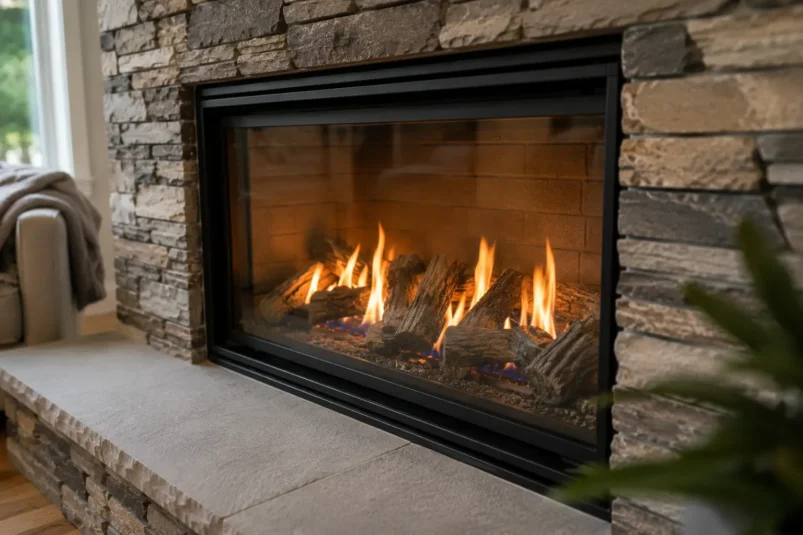

A gas fireplace works by drawing in air, mixing it with natural gas or propane at the burner, and igniting the mixture to create a controlled flame you can turn on with a switch or remote. A pilot light or electronic ignition starts the process.
A small safety device called a thermocouple keeps the gas valve open once the flame is lit. Depending on the vent type, exhaust gases are carried outside while the heat stays in your room.
The 3-step process behind every gas fireplace
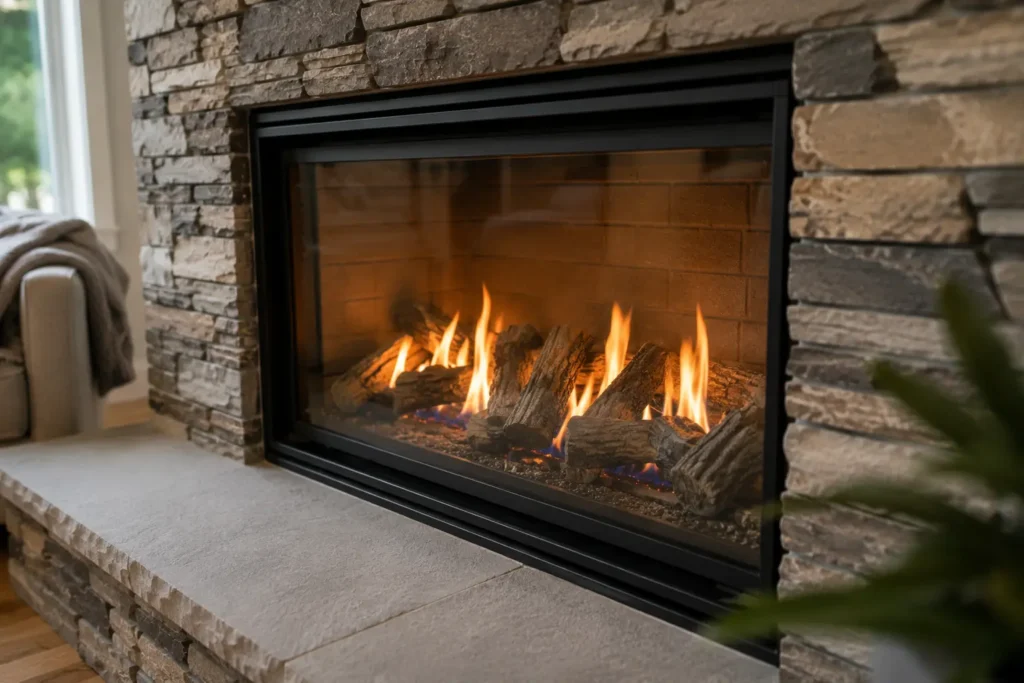
Every gas fireplace runs on the same three-step cycle: air intake, combustion, and exhaust. Air comes in to support the fire, either pulled from inside your home or drawn from outdoors through a sealed pipe. Gas mixes with that air at the burner and ignites, producing a flame and heat inside a steel firebox. The combustion byproducts leave through a flue or vent pipe, while the heat radiates into your room.
That cycle is the same whether you’re looking at a Heatilator, a Heat & Glo, or a Majestic unit. The only difference between the models is how the air enters and where the exhaust goes. That’s the part most homeowners really want explained.
The parts that make it happen
Gas valve, pilot & electronic ignition
A gas line feeds a valve that stays closed until something tells it to open. Older units use a standing pilot. That’s a small, continuous flame, watched over by the thermocouple. If the pilot goes out, the thermocouple cools, stops generating current, and shuts the gas off automatically. That’s the core safety mechanism in nearly every gas fireplace.
Newer units use electronic or intermittent pilot ignition (IPI) instead. A wall switch, remote, or thermostat signals the valve, and a spark lights the flame only when you want heat. It’s more fuel-efficient, though some homeowners still prefer a standing pilot because it keeps working without a battery.
Burner, media & the sealed glass front
Gas ignites along the burner’s surface, and burner design is a big part of why one fireplace’s flame looks like a soft campfire and another looks like a sharp ribbon of fire. Sitting on top is the media, ceramic logs, glass beads, or stone, arranged to catch the heat and glow rather than actually burn. In a direct-vent fireplace, all of this sits behind a sealed ceramic glass panel that keeps your indoor air fully separated from the fire.
Direct vent vs. B-vent vs. Ventless: What Miller Brick installs
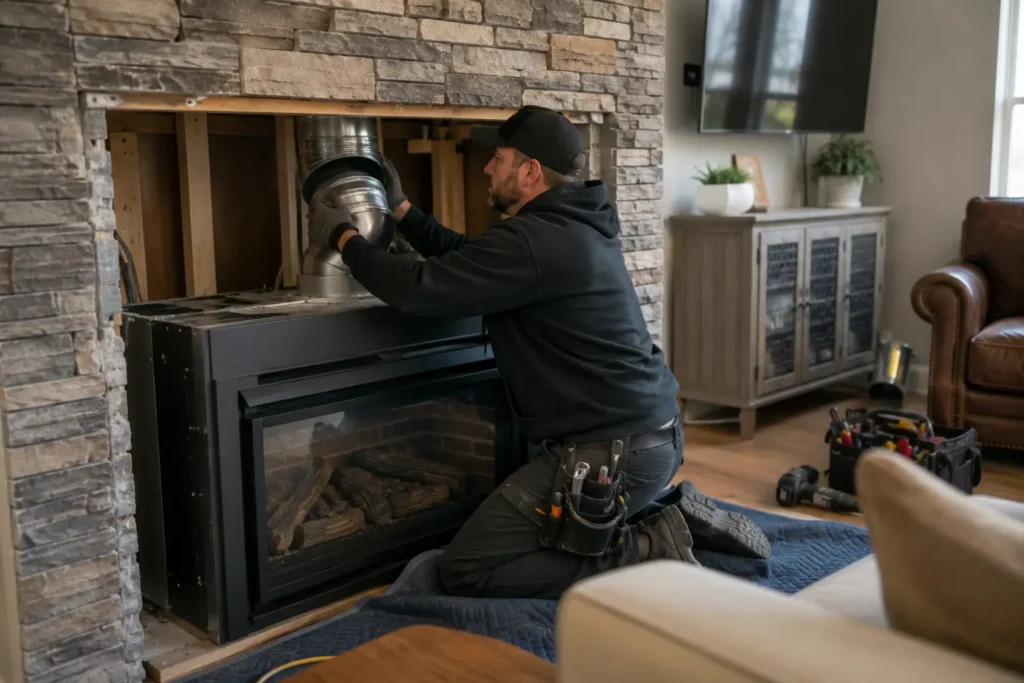
The vent type determines how a fireplace can be installed and how efficiently it heats. Three types exist on the market, though Miller Brick only installs two of them.
Here’s how they compare:
| Type | How it vents | Needs an existing chimney? | Does Miller Brick install it? |
| Direct vent | Sealed coaxial pipe pulls in outside air and pushes exhaust out | No | Yes |
| B-vent (natural vent) | Pulls air from the room, exhausts through a flue | Often uses one | Yes |
| Ventless (vent-free) | No venting; releases combustion byproducts into the room | No | No, not offered |
A direct-vent fireplace uses a sealed, coaxial pipe in which one chamber pulls in outside air and the other pushes exhaust out, so it can go in almost any room without an existing chimney. A B-vent unit pulls air from inside the room instead and exhausts it through a flue. Older homes converting from wood often reuse the existing masonry chimney for exactly that reason.
Ventless units skip venting altogether and release combustion byproducts straight into the room. They’re on the market, and homeowners ask about them by name, but Miller Brick doesn’t currently offer vent-free units. We only install direct-vent fireplaces, gas fireplace inserts, and gas log sets, so exhaust vents outside.
How much heat and gas does it actually use?
A gas fireplace heats a room two ways at once. Radiant heat passes through the glass and warms you, your furniture, and the walls, the way sunlight warms you through a window. Convective heat warms the air as it circulates past the hot firebox, either naturally or with a small fan.
Many direct vent models are rated somewhere in the 70 to 85 percent efficiency range, compared to roughly 15 percent for a traditional open, wood-burning fireplace, since almost none of that heat escapes up an open chimney. How much gas a unit uses comes down to its BTU rating and how many hours a day you run it, so the most accurate answer for your home is to check your model’s BTU rating with a technician.
Why Rochester homeowners like gas fireplaces specifically
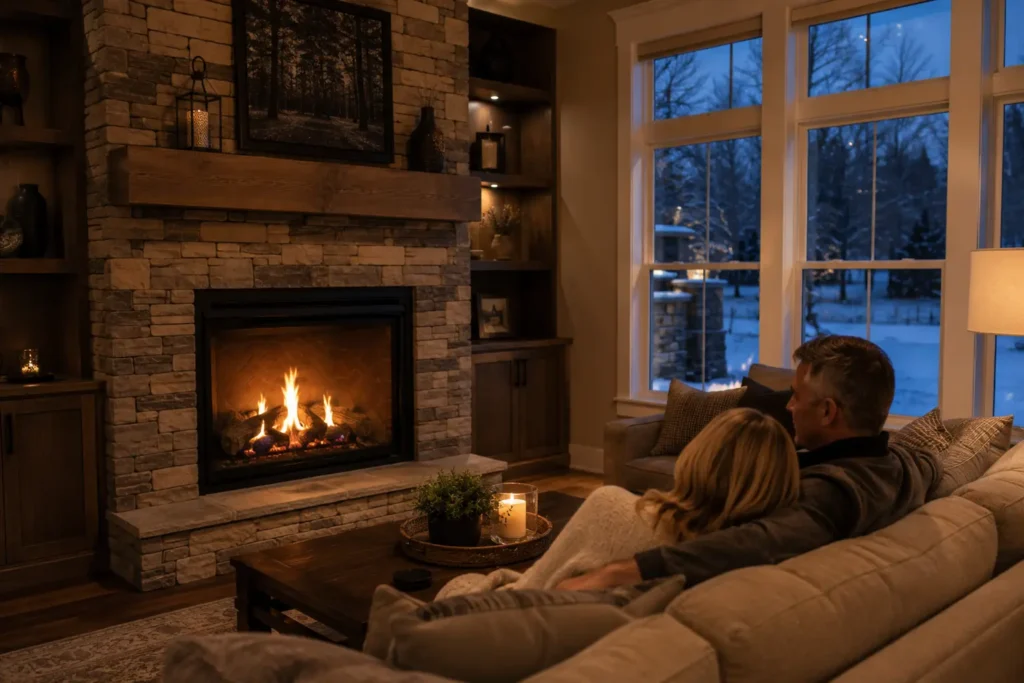
A gas fireplace is a zone heater, built to warm the room it’s in well rather than your whole house. Used that way, as a supplement to central heat in the room you actually spend time in, homeowners can meaningfully cut back on how hard their furnace runs.
There’s a second reason gas fireplaces matter here specifically. Many models, especially standing-pilot units, keep producing heat during a power outage because the pilot and thermocouple generate their own small electrical current. That’s a real advantage during a Rochester winter storm, when the furnace and any electric fireplace in the house may both be down, along with the power.
If you’re weighing a full gas fireplace against an insert, it usually comes down to whether you already have a working masonry chimney. An insert slides into that existing opening; a direct vent fireplace is built for homes that don’t have one.
FAQs
Are gas fireplaces safe?
Yes, when installed and maintained correctly. The thermocouple shut-off, an oxygen depletion sensor on some models, and sealed combustion all work together to keep the fire contained. A working carbon monoxide detector is still worth having in any home with a gas appliance, and an annual check-up by a certified technician catches small issues before they become safety problems.
Does a gas fireplace actually heat a room?
Yes. Most are built as real zone heaters, warming the room through a mix of radiant and convective heat. They’re not meant to heat an entire house, but in your main living space, they meaningfully supplement central heating.
Does a gas fireplace work during a power outage?
Many do. Standing-pilot and millivolt-style systems generate their own small current, so they don’t depend on household power. That’s worth something when a Rochester winter storm knocks the power out.
Do gas fireplaces use a lot of gas?
It depends on the unit’s BTU rating and how often you run it. The most reliable estimate for your home comes from checking that BTU rating with a technician.
What are the disadvantages of a gas fireplace?
The main tradeoffs are upfront installation cost, especially if a gas line needs to be run, and the fact that most units aren’t meant to replace whole-home heating. For most homeowners, the convenience outweighs these.
What’s the difference between a gas fireplace and a gas insert?
A gas fireplace is suitable for homes without an existing chimney. A gas insert slides into a masonry fireplace you already have, using the chimney that’s already there.
Get your gas fireplace serviced or installed in Rochester
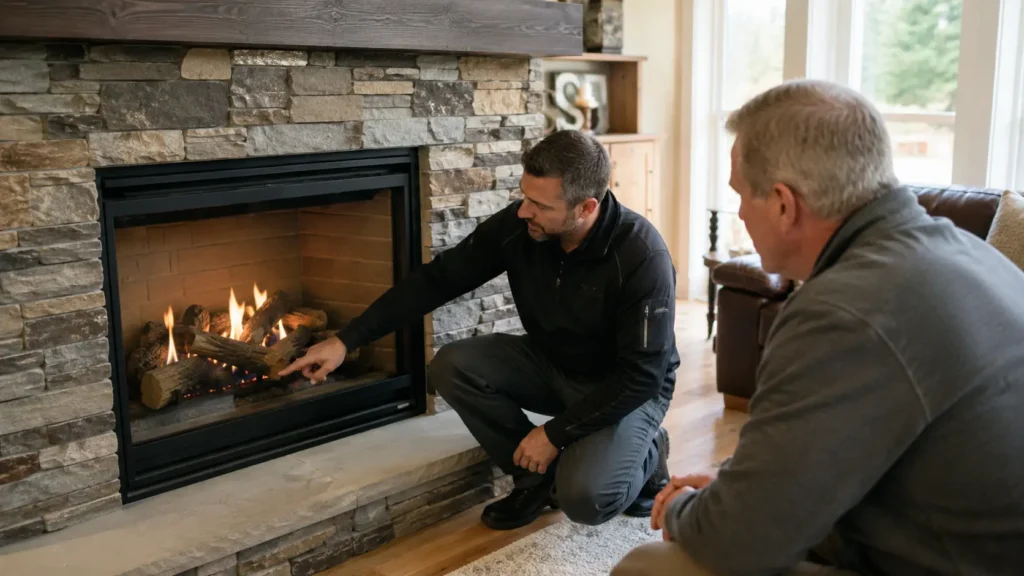
Understanding how your gas fireplace works is a good first step. Keeping it running safely is what matters year after year, and that’s where a professional check-up earns its cost back. Miller Brick’s fireplace service division installs and services Heatilator, Heat & Glo, and Majestic gas fireplaces, gas inserts, and gas log sets throughout Rochester, with certified technicians who can help you choose what actually fits your home.