
Yes, a ventless gas fireplace is safe when it’s sized right for the room, installed properly, and used the way the manufacturer intends. Skip any one of those conditions, and the risk changes fast.
This guide covers what actually happens when a ventless fireplace burns, the real risks worth knowing, and the safety features that make these units work as designed. It also walks through how a ventless fireplace compares to a direct vent one, so you can figure out which fits your home.
How a ventless gas fireplace actually works
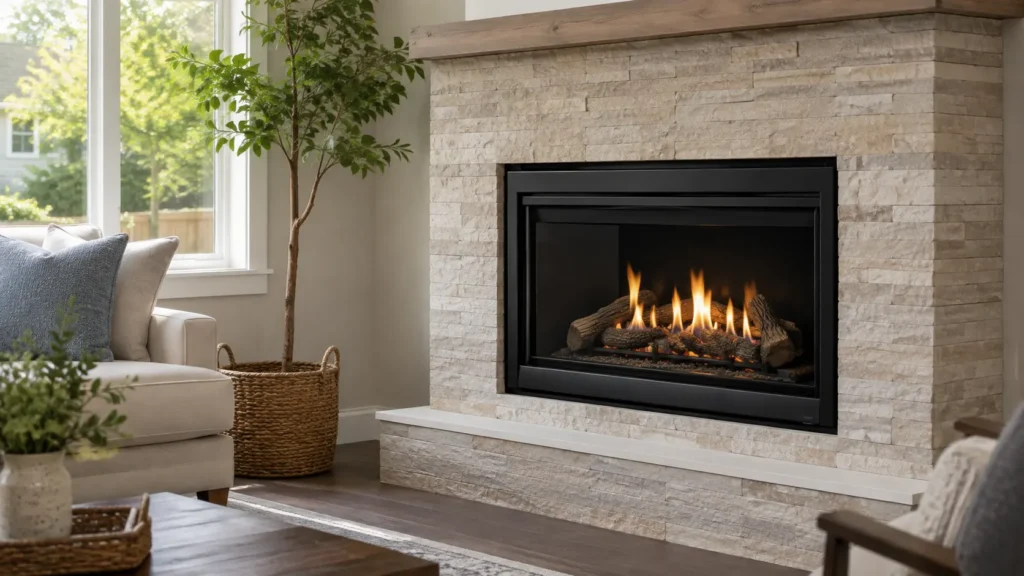
A ventless (or vent-free) gas fireplace burns natural gas or propane without a chimney or flue. Instead of pushing exhaust outside, it burns the fuel so efficiently that the leftover byproducts, mostly water vapor and small amounts of carbon dioxide, get released straight into the room. No vent pipe, no masonry chimney, no hole in the wall.
You can put one in a den, a finished basement, or a room that was never built for a fireplace. Installation costs less than a vented unit, too, since there’s no venting system to run. That’s also why the safety conversation looks different from what it does for a wood-burning or direct vent fireplace. Everything the fire produces stays in the room with you.
The real safety risks: Carbon monoxide and moisture
The two things to actually worry about with a ventless gas fireplace are carbon monoxide and moisture. Both come straight from the combustion process, and both are manageable, but only if the unit is sized and maintained correctly.
Carbon monoxide is odorless and invisible, which is exactly why it’s dangerous. According to CDC data reported by USAFacts, 624 people died from accidental carbon monoxide poisoning in the US in 2022, the highest yearly total in more than two decades. A properly functioning ventless fireplace produces only trace amounts of CO under normal operation. A poorly sized, damaged, or improperly maintained one is a different story, which is why a working carbon monoxide detector in the room isn’t optional.
The moisture side gets less attention but causes more everyday headaches. Burning natural gas releases water vapor as a byproduct. One longtime hearth installer puts it in concrete terms: roughly a gallon of water vapor comes off for every 100,000 BTUs, or one therm, of gas burned. Run a ventless unit for hours in a tightly sealed room, and that moisture has nowhere to go. Fogged windows, a musty smell, or peeling wallpaper near the fireplace are usually the first signs.
What actually keeps a ventless fireplace safe
A ventless gas fireplace stays safe through a specific set of engineered safeguards and usage rules, not luck. Every certified unit built and sold for US homes has to meet ANSI Z21.11.2, the national safety standard for vent-free gas appliances.
That standard, plus a handful of practical habits, is what separates a safe installation from a risky one:
- Oxygen Depletion Sensor (ODS): a built-in pilot assembly that shuts the gas valve automatically if room oxygen drops below roughly 18%, well before it becomes dangerous.
- Correct BTU-to-room sizing: ANSI Z21.11.2 requires a minimum of 50 cubic feet of room air volume for every 1,000 BTUs of appliance input. A 30,000 BTU unit needs roughly 1,500 cubic feet of air, about a 12-by-12 room with 11-foot ceilings, to burn safely.
- A dedicated carbon monoxide detector in the same room, tested monthly, separate from the unit’s built-in ODS.
- Limited run time, generally no more than two to four hours at a stretch, with a break in between.
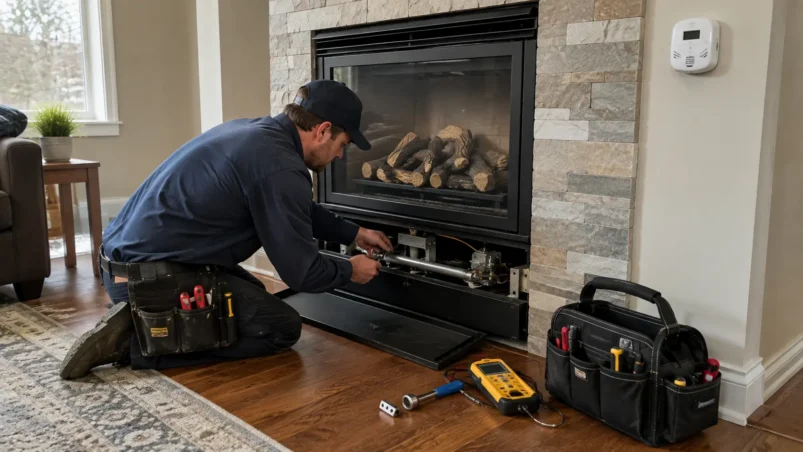
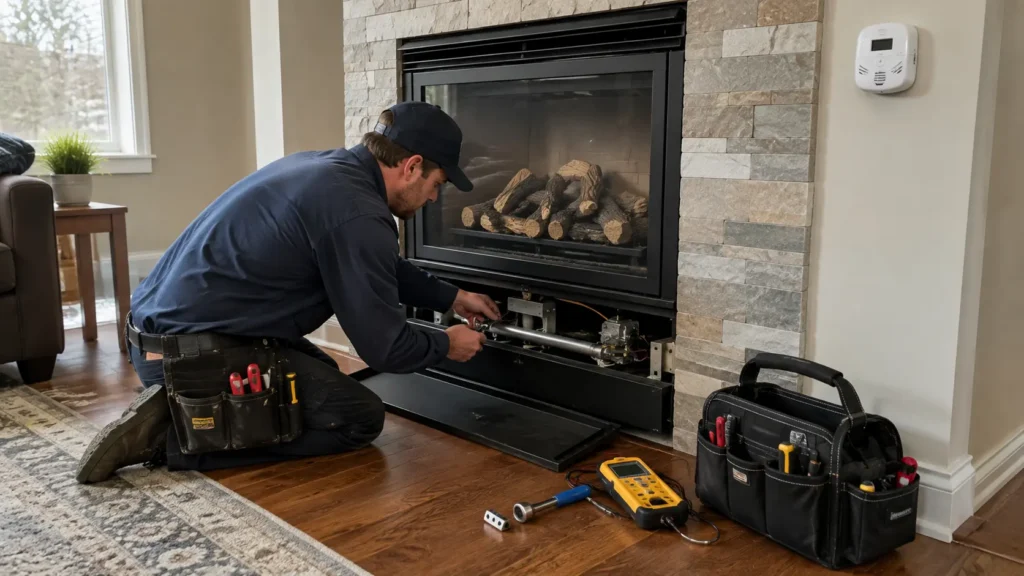
- Professional installation, since gas line work, clearance from combustibles, and correct log or media placement all affect how cleanly the unit burns.
- Annual inspection to catch a cracked log, a dust-clogged burner port, or a failing sensor before it becomes a problem.
Skip any one of these and the risk profile changes fast. Follow all of them and a ventless fireplace behaves the way it’s engineered to: efficiently, and without incident.
Ventless vs. Direct vent: Which is the safer choice?
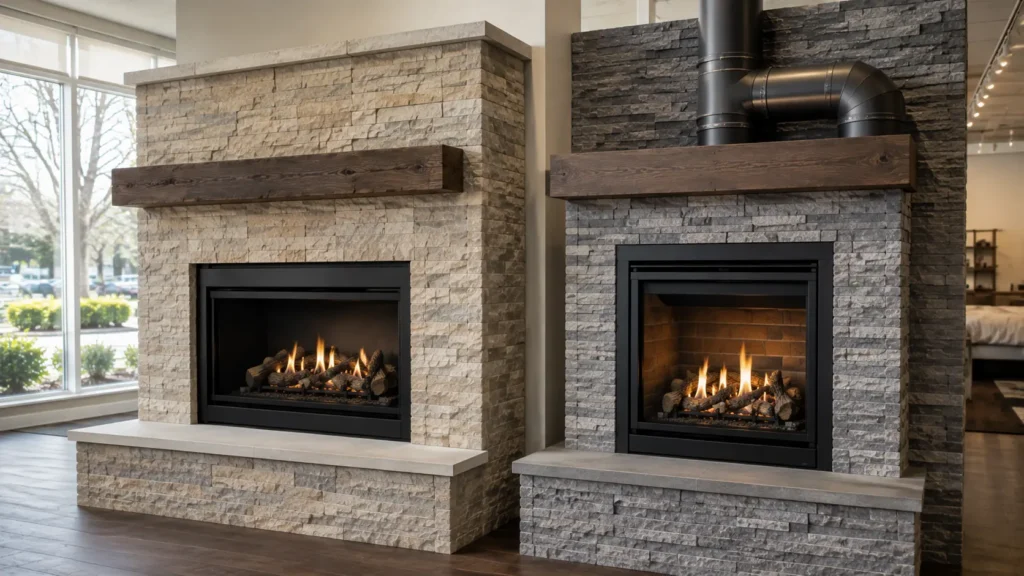
The bigger decision, once you know a ventless fireplace can be operated safely, is whether it’s actually the right type for your home. Direct vent fireplaces pull combustion air from outside and push every bit of exhaust back outside through a sealed pipe. That’s why most fire safety professionals treat them as the lower-risk option for a fireplace that runs daily.
| Factor | Ventless | Direct vent |
| Where exhaust goes | Released into the room | Sealed pipe to outside |
| Chimney or vent needed | No | Yes, a sealed vent pipe |
| Typical installed cost | Lower | Higher |
| Indoor moisture and CO exposure | Present, managed by ODS | Minimal, vented outside |
| Room and run-time restrictions | Yes, by code and ANSI standard | Few to none |
In short, ventless wins on upfront cost and installation flexibility. Direct vent wins on indoor air quality and fewer usage restrictions. That’s why it’s the more common pick for a primary living-room fireplace that runs every evening all winter. We’re an authorized service provider for three brands built mainly around direct vent technology: Heatilator, Heat & Glo, and Majestic. That’s a big part of why we steer daily-use customers in that direction.
Vented and ventless gas log sets are a different decision
Here’s where a lot of homeowners get confused, and it’s worth clearing up. A ventless gas fireplace is a self-contained appliance. A ventless gas log set is something different. It’s a set of gas logs installed inside an existing masonry fireplace opening, often in a home that already has a wood-burning firebox and chimney.
Both vented and ventless log sets exist. The right choice depends on whether your chimney still works and whether you want to keep using it for airflow. Ventless log sets burn cleaner and hotter, since none of the heat escapes up an open flue. But they carry the same room-sizing and ventilation rules as a full ventless fireplace appliance. Vented log sets are less efficient but let your existing chimney keep doing its job. Neither is automatically the better pick. It depends on your fireplace and what you actually use it for.
If you already have a working masonry fireplace and chimney, a wood fireplace gas conversion is often simpler than starting from zero with a ventless unit, since the airflow path already exists. If the chimney’s been capped, is deteriorating, or was never there to begin with, that’s usually where ventless options and gas fireplace inserts get compared side by side instead. A fireplace insert comparison is worth a look either way, since inserts and full fireplace replacements solve slightly different problems.
Keeping any gas fireplace safe year after year
Whichever type you end up with, the safety features only work if they’re checked. An oxygen depletion sensor that’s never been tested is a sensor you’re just hoping still works. A carbon monoxide detector past its battery life protects no one.
An annual fireplace checkup is what catches those problems before they matter. A technician who knows your specific brand can spot a cracked log, a dust-clogged burner, or a drifting sensor before the winter it actually counts. Our fireplace service division typically books two to three weeks out once the weather turns. That tells you how many homeowners already treat this as a yearly habit, not an afterthought.
FAQ: Ventless gas fireplace safety
Can I put a ventless gas fireplace in a bedroom?
Many local codes restrict or limit ventless units in bedrooms and bathrooms because of the smaller air volume in those rooms. Some jurisdictions allow low-BTU units under specific conditions. Check your local code before installing one in a sleeping area.
How long can I safely run a ventless gas fireplace?
Most manufacturers and fire safety guidance recommend no more than two to four hours of continuous use, followed by a break, to avoid moisture buildup and oxygen depletion in the room.
Do ventless gas fireplaces need a carbon monoxide detector?
Yes. The built-in oxygen depletion sensor is a safety feature, not a substitute for a separate, tested carbon monoxide detector in the same room.
Is a ventless gas fireplace cheaper than a direct vent one?
Usually, yes, mainly because there’s no venting system to install. Direct vent units cost more upfront but come with fewer placement and run-time restrictions over the life of the fireplace.
A ventless gas fireplace can be the right call for the right room. It isn’t a decision to make from a product listing alone, though. Get the sizing right, follow the usage rules, and weigh what you’re trading against a direct vent unit before you buy.