

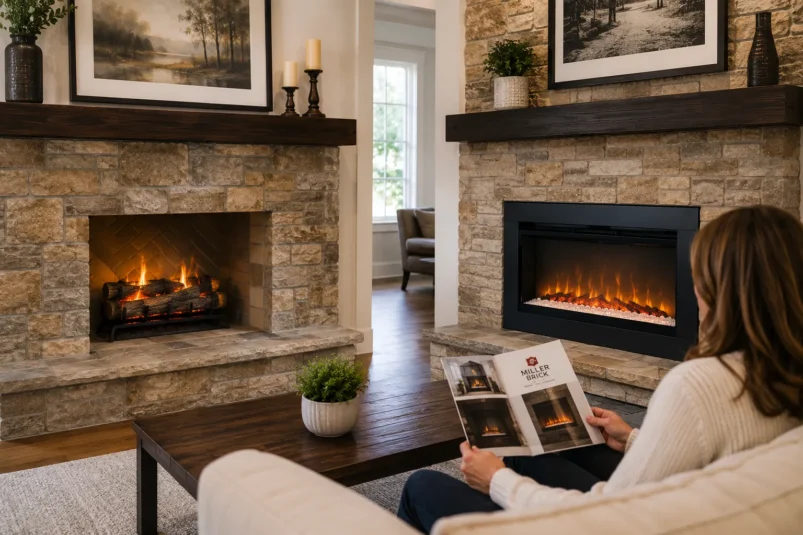
Converting a fireplace to electric typically costs between $300 and $5,000, depending on whether you’re starting from wood or gas. Wood conversions usually come in under $2,000. Gas fireplaces cost more, largely because a licensed technician needs to cap or remove the gas line first, a step that rarely shows up as its own line item in online estimates. Keep reading for the exact breakdown by fuel type, how converting compares to a brand-new install, and the specific things that raise or lower your total.
Converting a wood fireplace to electric
This is usually the cheapest of the three paths, since a wood-burning firebox already has an open cavity and no gas infrastructure to remove. The main costs are the insert itself, the labor to fit and secure it, and possibly a new electrical outlet if one isn’t already within reach.
| Item | Typical Cost |
| Electric insert or log set | $110–$1,035 |
| Installation labor | $150–$200 |
| New dedicated outlet (if needed) | $200–$750 |
Most wood-to-electric conversions land somewhere between $300 and $2,000 total, depending on the insert quality and whether an electrician needs to run a new circuit. If there’s already an outlet near the firebox, you’re on the low end of that range without much argument.
Converting a gas fireplace to electric
This path costs more, and the reason is almost never explained clearly in the cost guides that quote it: an existing gas line has to be safely capped or removed before anything electric goes in and that’s licensed work, not something bundled quietly into “installation.”
| Item | Typical Cost |
| Electric insert (basic to mid-range) | $300–$1,500 |
| Full gas-to-electric conversion (premium unit, more extensive work) | $1,000–$5,000 |
| Gas line capping or removal | Licensed plumber/gas fitter required; get this priced as its own line item |
The reason different sources quote such different numbers for the same conversion comes down to what’s included. A basic insert with the existing gas line simply capped falls near $200–$700 all in. A full renovation with a premium electric unit, new surround and more involved electrical work pushes toward the $1,000–$5,000 end. Ask any contractor to separate the gas-capping cost specifically, since that’s the step most online calculators fold into a vague “installation” number instead of pricing on its own.
New electric fireplace install vs. converting an existing one
Converting an existing wood or gas firebox with an insert is almost always cheaper than a brand-new build. A full new electric fireplace, especially a recessed, built-in or feature-wall installation, runs $4,000 to $12,000 once framing, electrical work and finishing are factored in and that’s before the unit itself which can range from around $1,000 for basic plug-in models to $8,000 or more for premium built-ins.
A conversion skips nearly all of that. The opening, surround, and mantel are already there. You’re paying for the insert, the labor to fit it, and any electrical work the location needs, not new construction. New installs make more sense when you don’t have an existing fireplace opening at all, or you want the fireplace in a different room entirely. If you’re still weighing whether electric is the right fuel type at all, we’ve laid out the fuller electric vs gas trade-offs separately.
Electric fireplace insert cost vs. electric log set
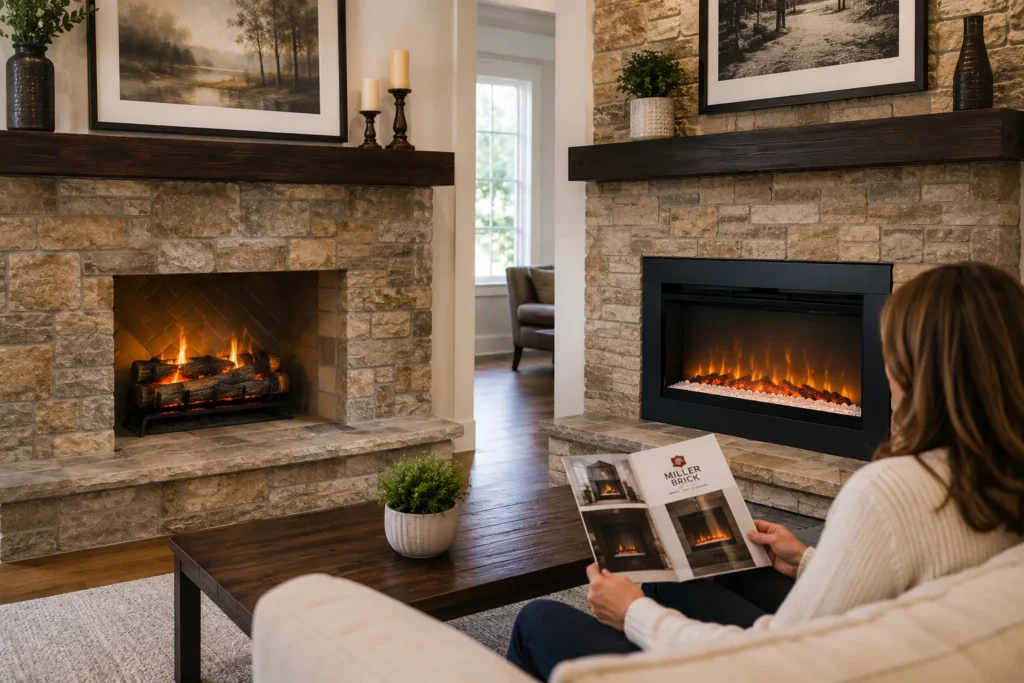
This is a decision point that most cost guides skip past, and it changes the number more than almost anything else on this page. An electric log set, the simplest option, often sells for under $200 and drops into an existing firebox opening with minimal fuss. An electric insert costs closer to $800–$1,500, but it typically offers better heat output, a cleaner finished look, and remote or app control. For comparison, a full gas-fueled conversion runs closer to $3,500. If ambiance matters more than heat output, a log set gets you there for a fraction of the cost. If you want the insert to actually warm the room, the higher price of a proper insert is usually worth it.
What affects the final price
- Starting fuel type: wood is cheaper to convert than gas, because of the line-capping step gas requires.
- Insert size and BTU output: higher-output units cost more and heat a larger area.
- Electrical work needed: a new dedicated outlet or circuit adds $200–$750.
- Features: flame realism, app or remote control, and multiple heat settings all push the price of the unit up.
- Surround or mantel changes: reusing the existing opening keeps costs down; reshaping it to fit a different insert size adds finish work.
- Regional labor rates: electrician and installer rates vary by market and affect the labor portion of every estimate above.
Electric fireplace vs. gas fireplace efficiency
Electric fireplaces convert essentially all of the electricity they draw into heat, which sounds like a clear efficiency win, but the real comparison depends on local energy rates and how the fireplace is actually used. Running an electric fireplace in heat mode typically costs somewhere between $0.08 and $0.23 an hour depending on wattage and electricity rates, which works out to roughly $25 to $120 a year for the kind of occasional evening use most households get out of a fireplace. A gas fireplace used more heavily, several hours a day through a cold season, can run closer to $460 a year in fuel cost, though gas also delivers far more raw heat output (a gas unit can put out 30,000+ BTUs, compared to roughly 5,000–8,900 BTUs from most electric inserts).
In practice, that makes electricity the more efficient and predictable choice for ambiance or supplemental zone heating in one room, while a gas fireplace still has the edge if you’re relying on it as a real heat source for a larger space.
Choosing the best electric insert for an existing fireplace

Start by measuring the firebox opening before shopping. Electric inserts are built to standard size ranges, but a mismatch means custom trim work you didn’t budget for. Decide early whether you actually want heat output or just the flame effect. Many inserts offer a flame-only mode that draws a fraction of the power which matters if the room already has its own heat source. Plug-in units are simpler and cheaper to install than hardwired ones, but a hardwired insert usually looks more finished, since there’s no visible cord.
If you’re not sure which route fits your fireplace and budget, seeing the options in person tends to clarify things faster than another cost calculator will. Our design center has working displays you can compare side by side before deciding.
Every one of these numbers is a starting point, not a quote. The fastest way to get an accurate number for your specific fireplace, wood or gas, is to have someone look at the actual opening, wiring, and gas line before you commit to a budget.