
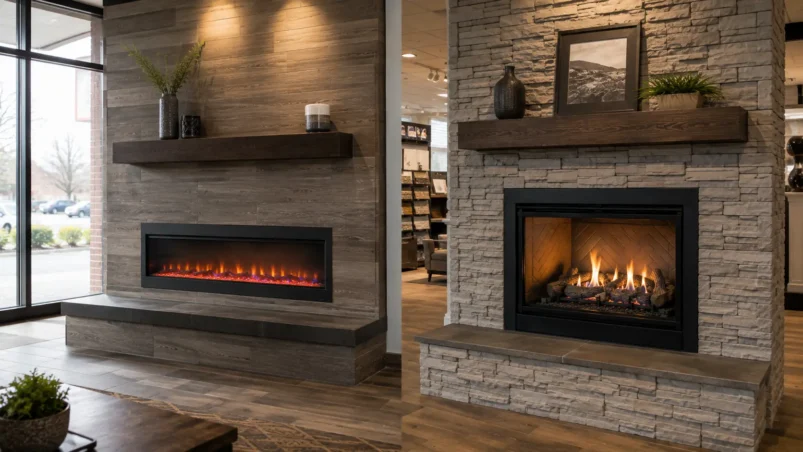
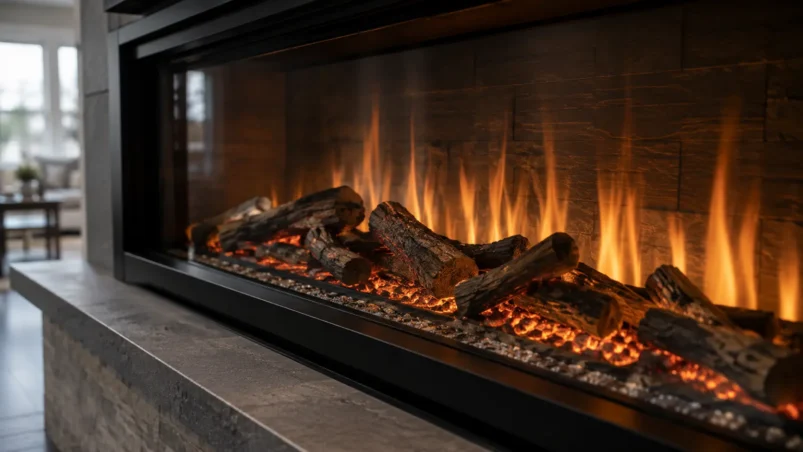
An electric fireplace doesn’t burn anything. The heat comes from a heating element, usually a coil, a ceramic plate, or an infrared quartz tube, and the flames come from LED lights bouncing off a shaped panel or mirror. That’s the entire trick: real warmth, fake fire, no chimney required.
If you’re weighing one for a room that can’t support a gas line or a flue, or you just want to know what’s actually happening behind that glowing glass, here’s what you need to know: how the heat gets made, how the flame effect is faked, what it actually costs to run here in Rochester, and the one thing electric still can’t do that gas can.
How the heat gets made
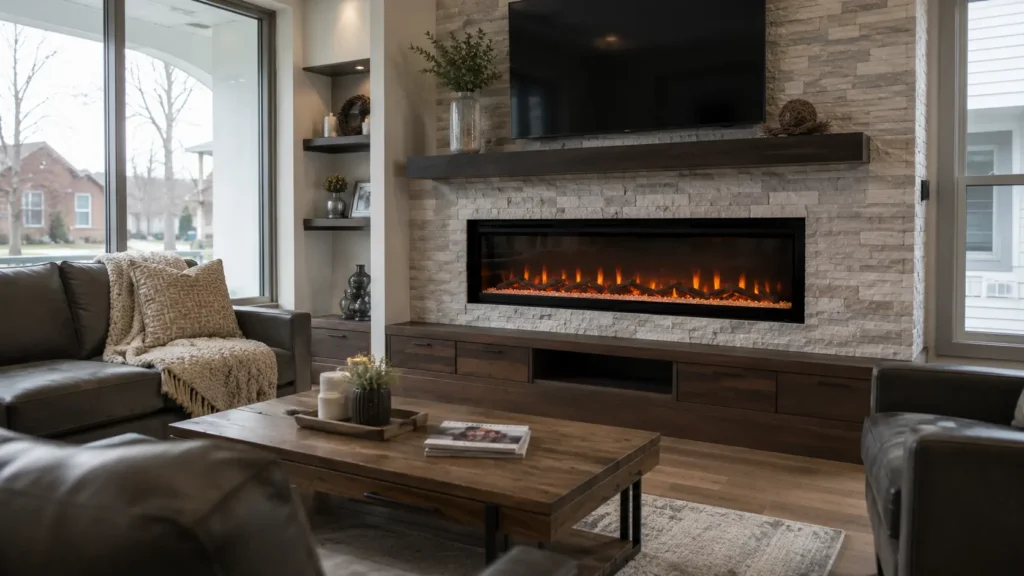
Most electric fireplaces use one of three heating methods: a heating coil, a ceramic plate, or an infrared quartz element. A heating coil warms the air passing over it, and a fan pushes that warm air out into the room. It’s the same basic idea as a household space heater, just built into a firebox-shaped cabinet.
Ceramic plates and infrared quartz units work differently. Instead of heating the air first, they radiate heat directly at whatever’s in front of them, furniture, floors, you. In particular, infrared skips the fan in some models, which means quieter operation and heat that reaches you almost immediately rather than waiting for the air to warm up.
Whichever method a unit uses, nearly all the electricity it draws turns into heat in the room. There’s no chimney pulling warmth up and out the way there is with a wood fire, which is one reason electric units can feel surprisingly effective for their size.
How the flame effect works (No real fire involved)
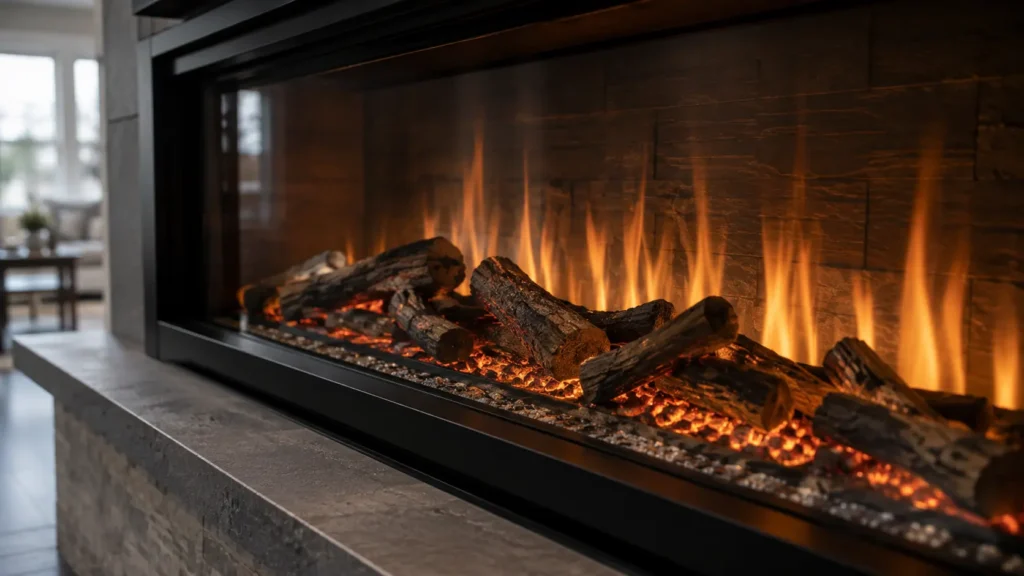
The flames aren’t flames. Most units run an array of LED lights behind a molded, ridged panel that bends and scatters the light so it flickers and shifts the way real fire does. Older or cheaper models use a spinning mirror or a lit fabric strip instead, which looks less convincing up close but does the same basic job.
Higher-end units sometimes add a water-vapor mist, lit from below by the same LEDs, for a softer, three-dimensional look that’s closer to smoke and flame together. That effect started showing up in fireplaces in the late 2000s and has become common in premium models since.
Because the flame system and the heater are separate, you can run the flame effect without any heat at all, useful in July when you still want the ambiance but not the warmth.
What it actually costs to run
Cost comes down to wattage and your electricity rate. Most units run at 750 watts on low and 1,500 watts on high, with flame-only mode drawing closer to 100 watts. Multiply the wattage by your rate per kilowatt-hour, and you have your cost per hour.
Recent local rate comparisons put RG&E-territory electricity somewhere between roughly 13 and 21 cents per kilowatt-hour, depending on your supplier and the season. The table below uses 15 cents per kilowatt-hour as a middle-of-the-road number.
Check a recent bill and swap in your actual rate for an exact figure.
| Setting | Typical wattage | Cost per Hour (at 15¢/kWh) | 4 Hours a Day, 30 Days |
| Flame only, no heat | ~100W | ~2 cents | ~$1.80 |
| Low heat | 750W | ~11 cents | ~$13.50 |
| High heat | 1,500W | ~23 cents | ~$27.00 |
A couple of hours a night at high heat runs about $10 to $15 a month, not the budget-buster a lot of people assume. Manufacturers typically rate a 1,500-watt unit around 4,700 to 5,100 BTUs. That wattage and BTU range should sound familiar, because it’s nearly identical to a standard space heater, which is exactly the comparison a lot of homeowners end up making.
Isn’t this just a space heater?
Fair question, and there’s some truth to it. Strip away the mantel and the flame panel, and the heating side of an electric fireplace really is doing the same job as a plug-in space heater: pulling electricity, converting it to heat, and pushing it into the room. Nobody’s hiding that.
What’s different is the rest of the package. An electric fireplace is built and rated as a fixed piece of furniture, not a portable heater you kick under a desk, and it doubles as a design feature, a mantel, a media console, a built-in focal point, that a space heater never will. You’re paying for the cabinet and the flame effect as much as you are for the heat.
If the space-heater comparison doesn’t bother you and you’re leaning toward electric anyway, we’ve laid out the fuller case for why choosing electric makes sense for many Rochester homes, especially those without an existing chimney or gas line.
What electric fireplaces can’t do
Here’s the honest limitation nobody selling one wants to lead with: electric fireplaces need power to work, period. No electricity, no flame effect, no heat.
That matters more in Rochester than in a lot of places, since lake-effect storms take down power lines most winters. A standing-pilot gas fireplace can often keep emitting radiant heat during an outage, even with the blower fan off, because the flame itself doesn’t require electricity. An electric unit goes dark and cold right along with everything else in the house.
It’s also worth saying plainly that a simulated flame is still a simulated flame. If the sound, the smell, and the unpredictable flicker of a real fire matter to you, no LED panel fully replaces that. Most homeowners who choose electric are trading that for convenience, not pretending the trade doesn’t exist.
Electric vs. Gas, at a glance
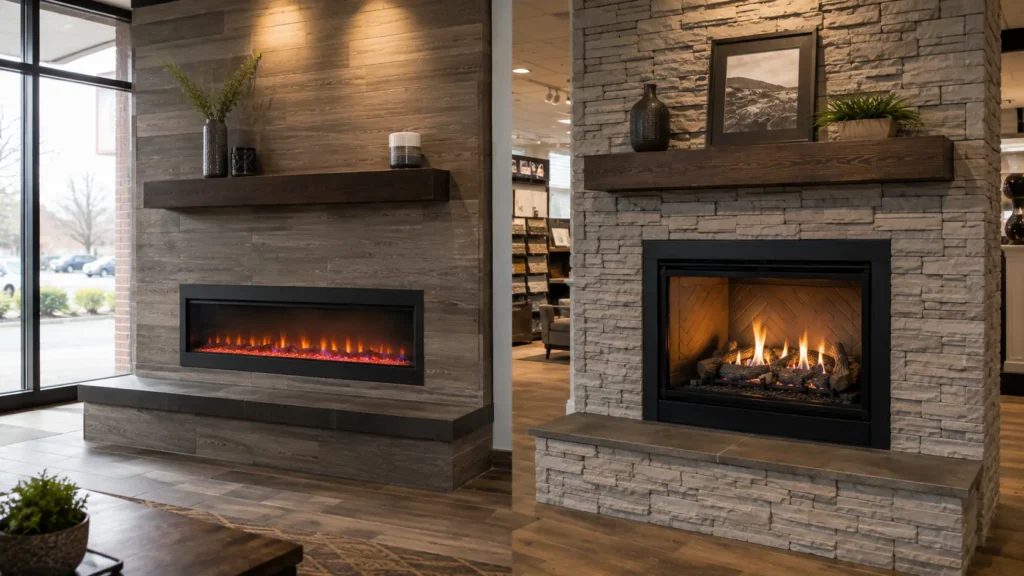
Neither fuel type is universally better. It comes down to what your space can support and what problem you’re actually solving.
| Electric | Gas | |
| Venting or chimney | Not needed | Vented or vent-free unit required |
| Typical installation | Plug into an outlet | Gas line, sometimes venting work |
| Carbon monoxide risk | None | Low, with proper venting and annual checks |
| Works during a power outage | No | Standing-pilot models can still radiate heat |
| Flame realism | Simulated, LED-based | Real flame |
If you already have a chimney and want the real thing, gas usually wins. If you don’t, or you’re heating a condo, an apartment, or a room where running a flue just isn’t realistic, electric closes that gap without any construction. For a full room-by-room breakdown, our electric vs gas guide walks through which one fits your specific situation.
Installation and safety basics
Most freestanding, mantel, and insert-style units plug straight into a standard wall outlet. No electrician needed for a portable unit. Larger built-in linear fireplaces are sometimes wired to their own dedicated circuit instead, so ask an electrician if you’re not sure what else is running on the outlet you’re planning to use.
Plug it directly into the wall. Extension cords and power strips aren’t rated for the draw these units pull, and running one through an extension cord long-term is a real fire risk. If the fireplace shares a circuit with a window air conditioner or a hair dryer, don’t be surprised if the 1,500-watt setting trips the breaker now and then.
Beyond that, look for the basics: a cool-touch glass front, automatic overheat shut-off, and a UL or CSA safety listing on the tag. Those three features are the difference between a well-built unit and a bargain-bin one, regardless of brand.
Frequently asked questions
Can I leave an electric fireplace on overnight?
Most modern units with overheat protection and a timer are safe to run for a few hours unattended, but manufacturers generally still recommend switching to flame-only mode, or turning the heater off entirely, before you go to sleep or leave the house for an extended stretch.
Will an electric fireplace heat my whole house?
No. A typical 1,500-watt unit is built for zone heating, warming the single room it’s in, not a whole floor. Manufacturers usually rate them for 400 to 1,000 square feet depending on the model and how well the room holds heat.
Do electric fireplaces need a chimney or vent?
No. Since there’s no real combustion happening, there’s nothing that needs venting. That’s the main reason electric units end up in condos, apartments, and rooms where running a flue was never an option.
How much maintenance do they need?
Very little. Wipe the glass, dust the vents occasionally, and check the cord and plug for wear now and then. There’s no soot, no ash, and none of the annual chimney sweeping a wood-burning fireplace requires.
Miller Brick carries a range of Heatilator electric fireplaces, and every one on the floor is running when you walk in, so you can watch the flame effect and feel the heat before you commit to anything. Come compare them in person at the design center visit area of our Ridgeway Avenue showroom.